Self-Booking — the marketing play
Updated to the 10 Jul intake-flow call (Suciu · Codrut · Vlad T). What marketing ships, for both brands, and how we prove it. Engineering & HubSpot detail is a separate companion doc (engineering-appendix.html).
The one-paragraph version
Self-booking flips our funnel. Today we capture a lead then chase them to book. Now the patient books themselves first — the site leads with "pick a therapist and book," and coverage is confirmed in the back office. So marketing's job becomes two things: get every booking to actually show up, and harvest the two openings self-booking hands us almost for free.
Those two openings: (1) waking up a large dormant database — ~97% of past PRE contacts never became a patient — with a "book yourself in minutes" nudge (note: anyone inactive >6 months re-enters as a new-patient intake); and (2) we can finally sell — and instantly deliver — the end result: book a real therapist this week, straight from the ad ("Book a session now"), with coverage as a trust line, not the pitch. Direct comms (SMS + email) is the engine, now across both Positive Reset and Serenium on one shared platform.
Peter's north star, now locked by the call: don't make our flow stricter than ZocDoc — capture the booking first, verify & share cost on the backend. A few engineering pieces still gate launch (attribution, the duplicate-contact fix, old-cycle suppression) — in the companion doc.
What the 10 Jul call decided this drives the plan
The intake-flow debate (Suciu · Codrut · Vlad T) resolved six things that reshape marketing. Blue = shapes our messaging; green = a marketing task.
The finalized flow from the call · both brands
Booking comes first; insurance and verification move to the back office. Marketing's job: attach the right message to each step, automatically.
The marketing play direct comms is the engine
Direct comms — the SMS + email lifecycle — is our primary channel for both brands. It drives reactivation, keeping bookings, and repeat visits. Ads bring people in; comms turn them into patients who show up and come back. The two biggest near-free wins — reactivating the dormant base and seeding lookalikes from real patients — are both things self-booking uniquely unlocks.
| Stage | Priority | What we do first | Why it matters |
|---|---|---|---|
| Acquisition | primary | Outcome-led ads ("Talk to someone this week" · "Start therapy this week") with a "Book a session now" CTA on Meta, plus PRE + SW Google Search pointed at the new booking flow. Coverage = trust line, never the CTA. | Meta is the volume workhorse; Search already catches high-intent Medicaid-coverage queries (Google Ads section). |
| Reactivation · direct comms | primary | SMS + email to the dormant base — old leads, no-shows, exhausted-attempt, Nurture. "Book yourself in minutes." Copy handles the 6-month → new-intake rule. Consent-gated. | The biggest near-free win. ~97% of past PRE contacts never became a patient — self-booking finally gives them a one-tap way in. |
| Show-up / no-show · direct comms | primary | Reminder + pre-session prep + no-show rebook. Pre-empt the intake card-upload drop-off ("have your insurance card ready"). | A no-show = full ad cost, zero return. Cheapest patient we'll ever get is the one who already booked. |
| Retention · direct comms | primary | After the first session → book-the-second-session SMS/email. | Where the real lifetime value is, especially for private-pay patients. |
| Referral + reviews | secondary | Post-visit review + referral ask. | Feeds Google rank + ad trust — slower, compounding. |
| Organic / Google + ZocDoc | secondary | Keep listings current (accepted insurers, self-book link, hours) + a coverage-check page for SEO. | Parity with Peter's ZocDoc/GBP benchmark; supports paid, doesn't lead it. |
Peter's brief, mapped
- 1 · Patient-facing messaging & 2 · Follow-up sequences → the comms journey below — every message, every state.
- 4 · After booking · 5 · Intake · 6 · Medicare/EAP · 7 · Pending / review → each is a labeled stage in that journey, with draft copy.
- 3 · HubSpot lifecycle → the engineering companion doc (the plumbing, not marketing's build).
The comms journey who we message, when, and with what
The funnel-flip made concrete: every SMS + email a patient gets, at each step — in the new book-first order. This is the state-by-state copy for Monday.
[date], [carrier], [$copay] fill from the record. Blue tags map each step to Peter's brief.
One CTA: "Book a session now" lead with the outcome
Per the call (Suciu): lead with the end result the patient actually wants — getting seen, talking to someone this week — not the coverage-check process. One CTA everywhere: "Book a session now." Coverage stays a small trust line ("Medicaid & most NJ plans"), never the hook. No "Check your coverage" CTA on ads.
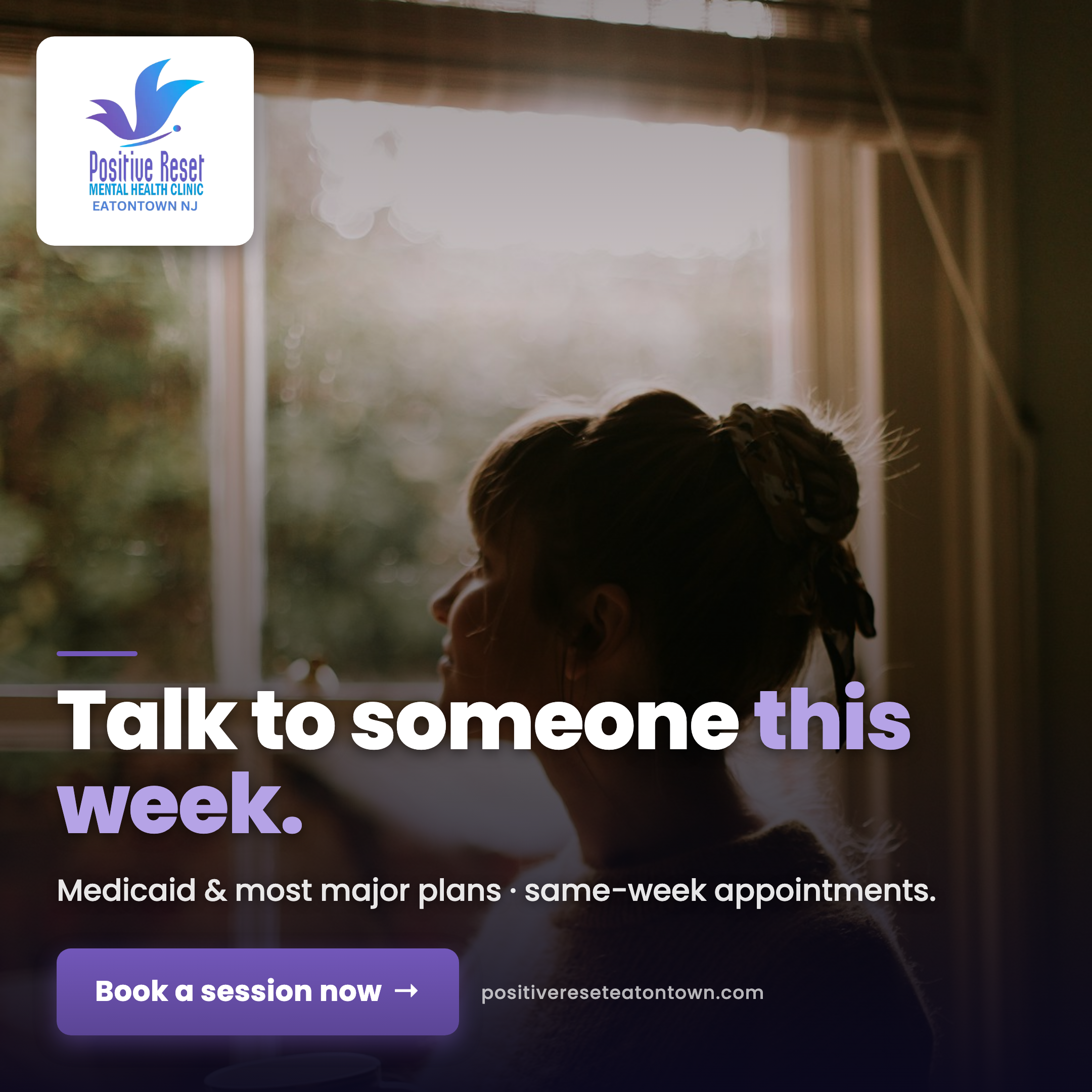
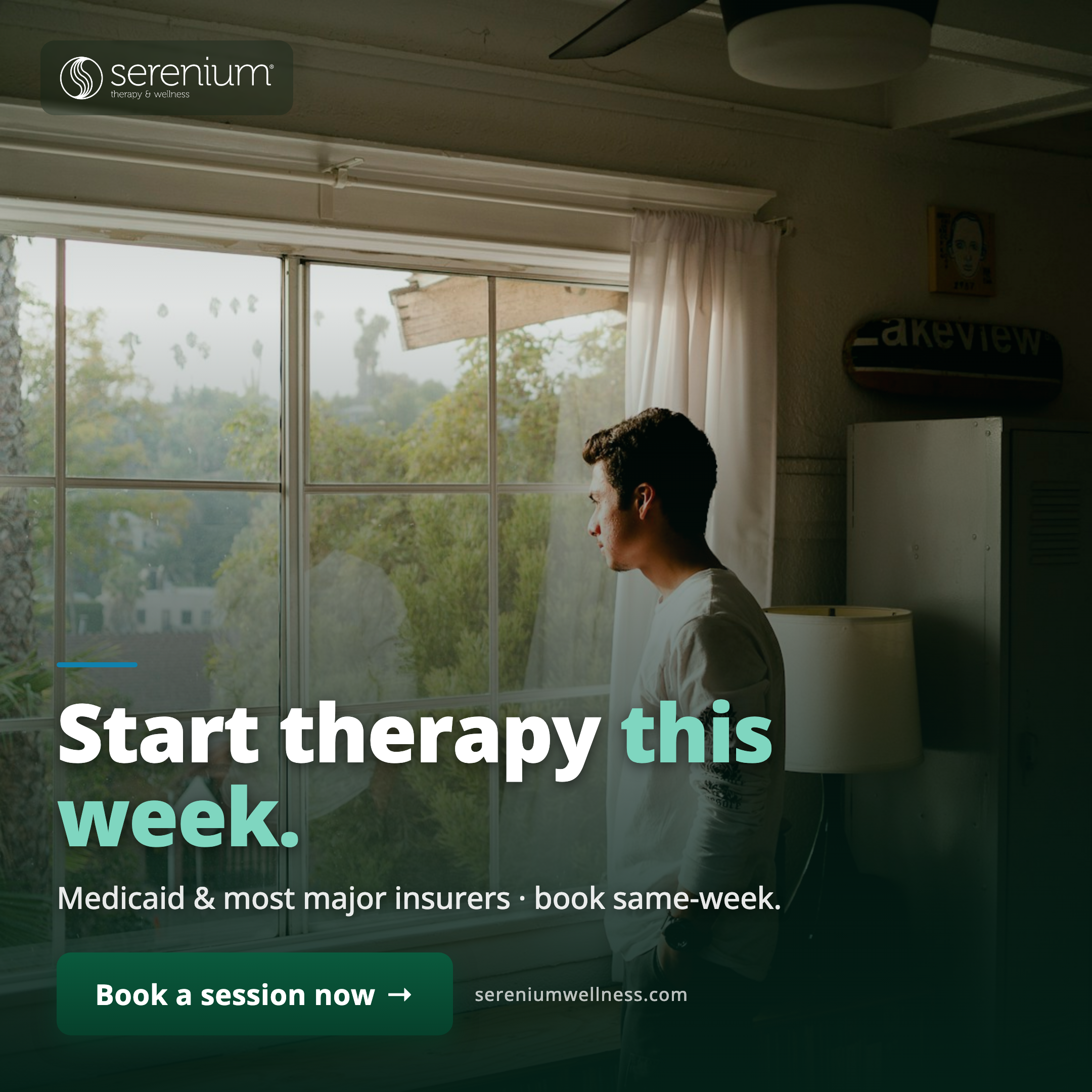
The rule
- Headline = the end result — "see a therapist this week," "talk to someone," "real support, now." Not the process.
- CTA = "Book a session now" — only. No "Check your coverage" on ads.
- Coverage / cost = a trust subline ("Medicaid & most NJ plans · same-week"), never the pitch.
- The coverage check still exists — on the site + in the back office — it's just not the ad hook.
Kept drafts — coverage & process concepts not deleted · repurposed
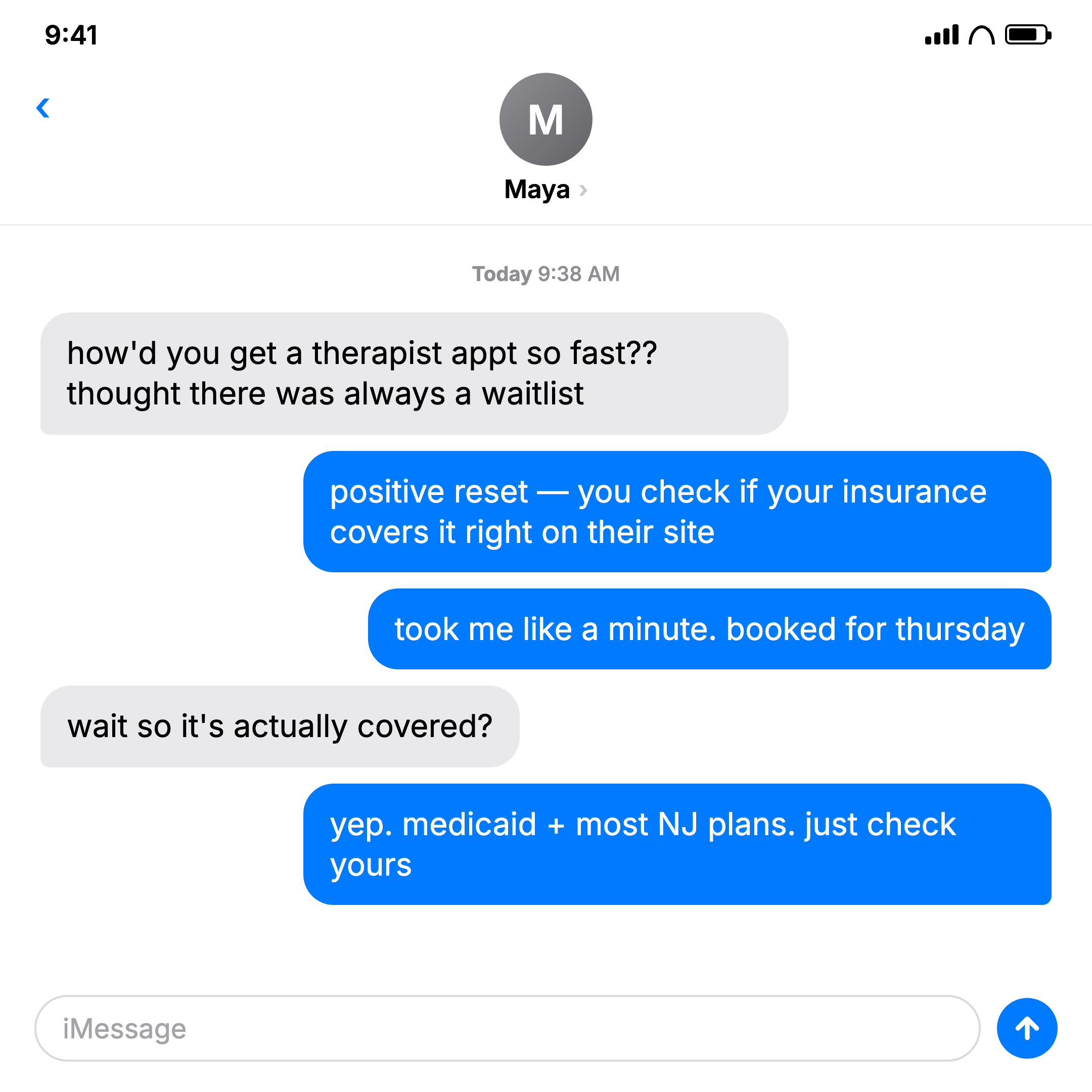
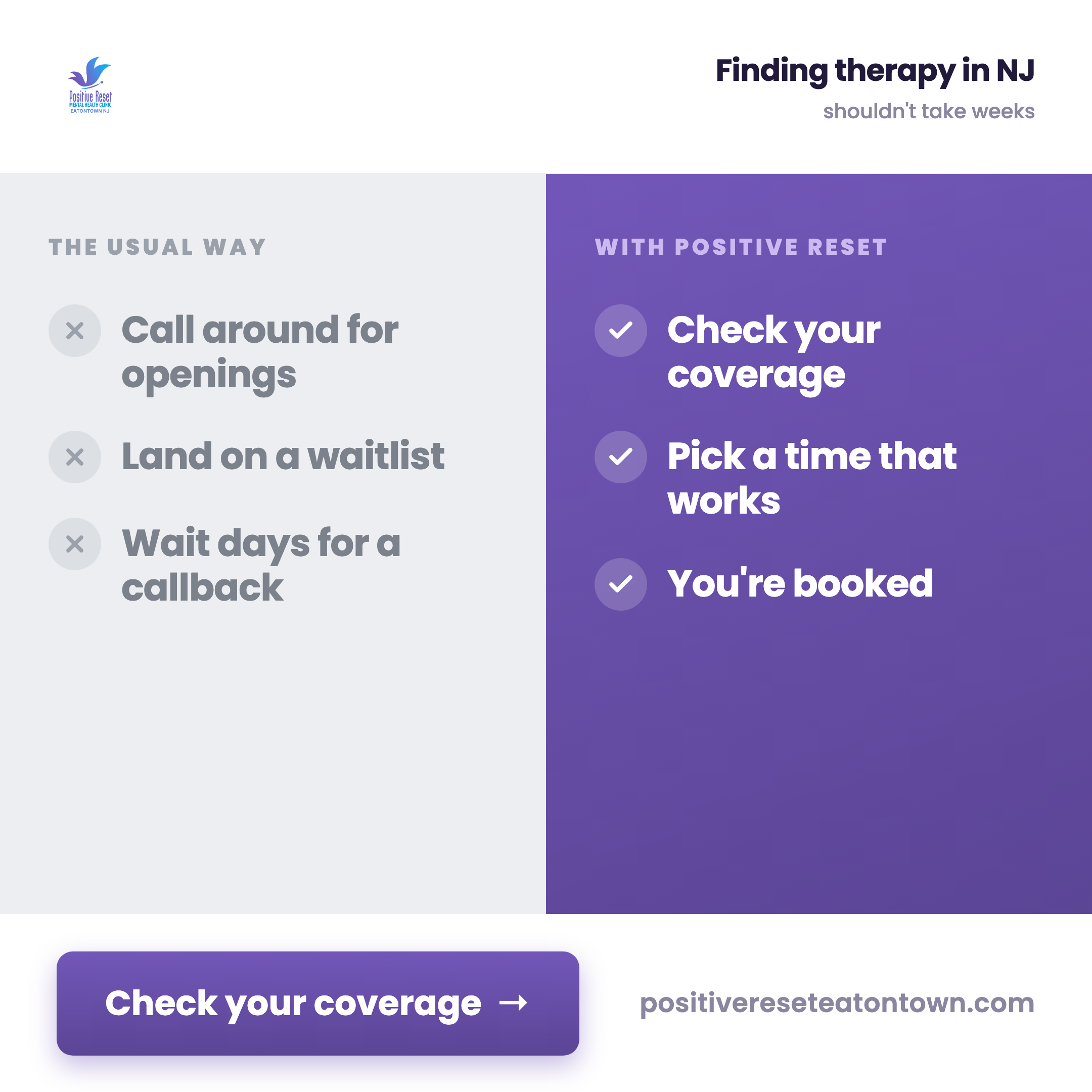
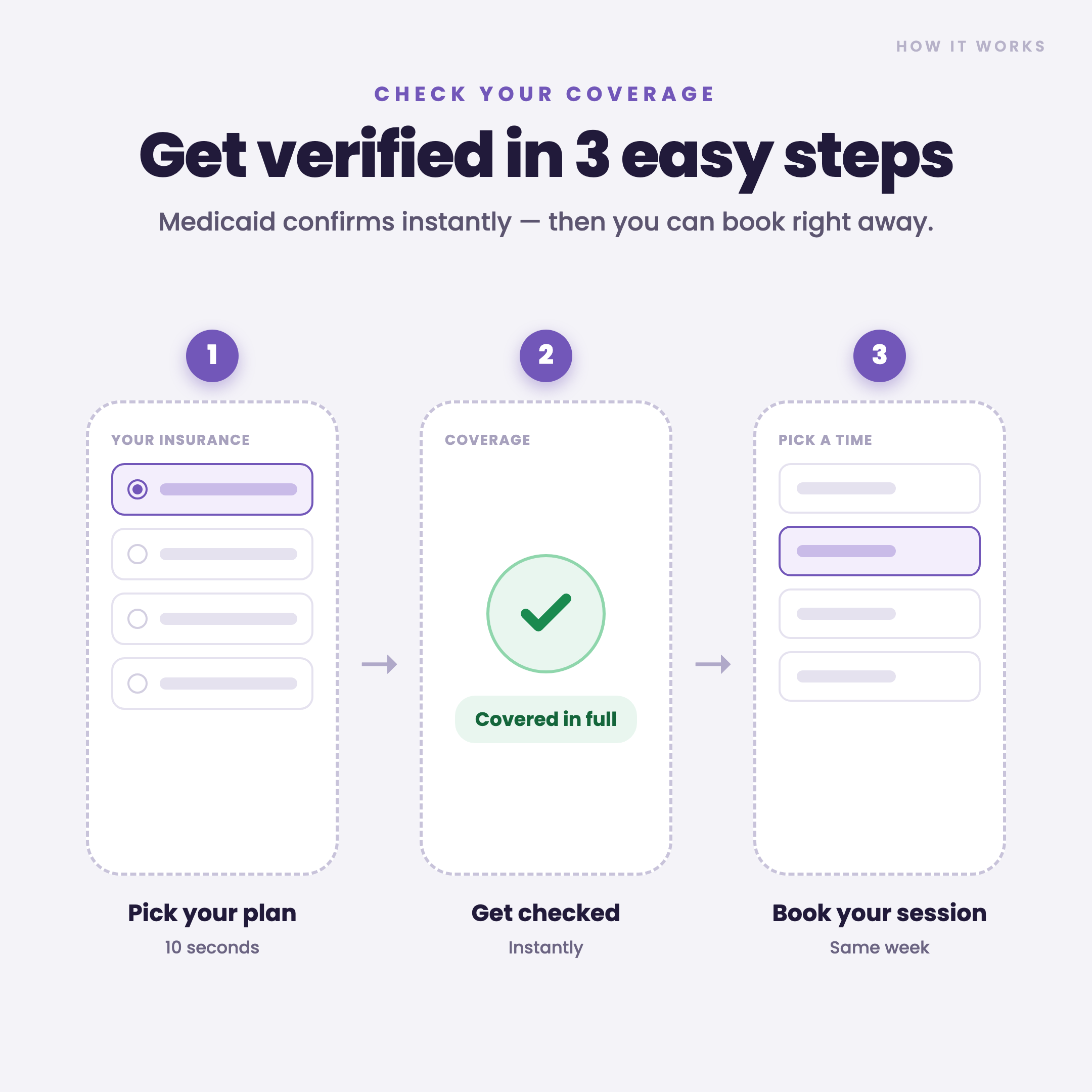
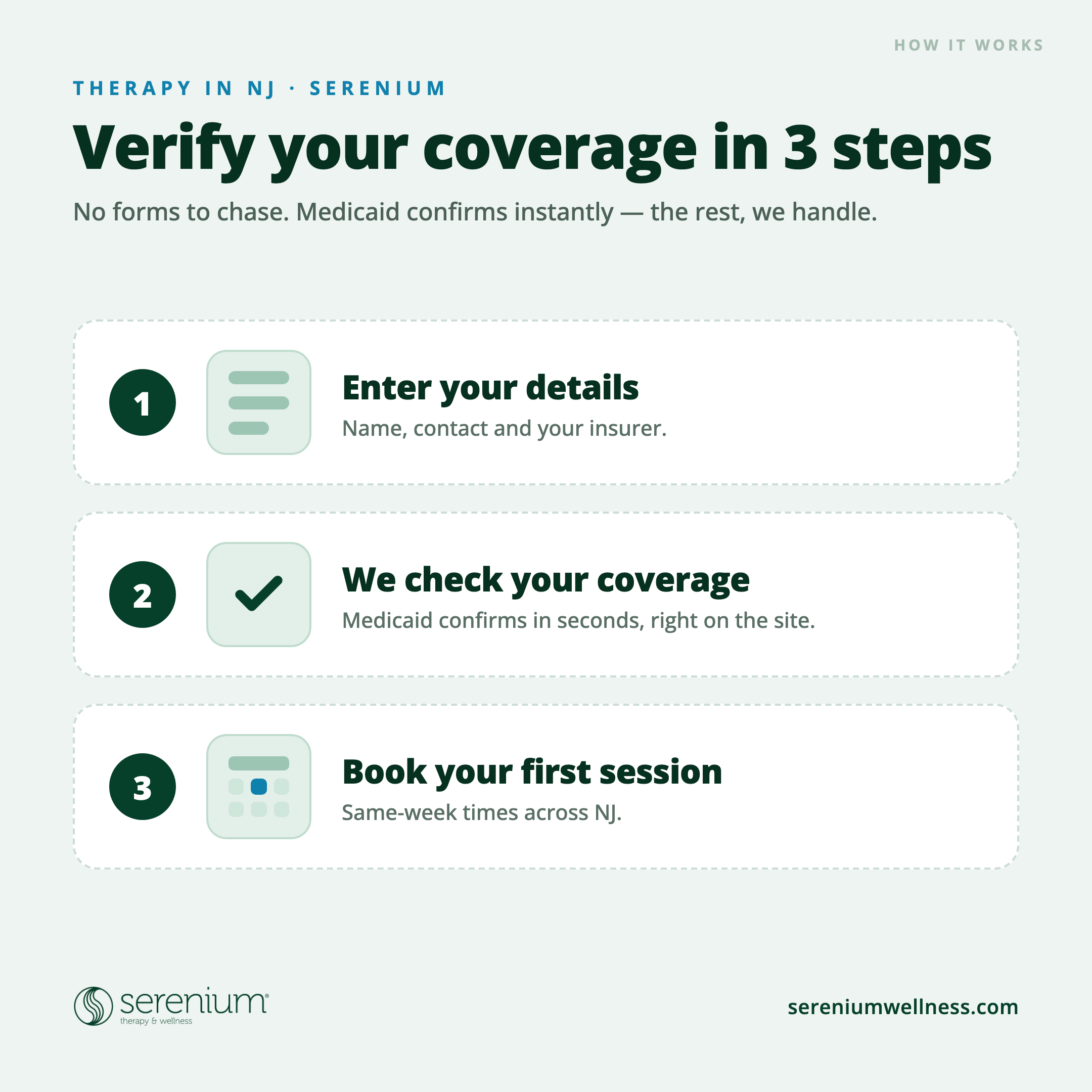
Built for the earlier coverage-first angle — kept, not thrown away. Repurposed: the "how it works" explainers fit the on-site page + retargeting (warm clickers who didn't book); the social / comparison formats get outcome copy + the book CTA. Old coverage versions of the heroes preserved in /drafts. These verify-step cards live in the flow, not as the lead ad.
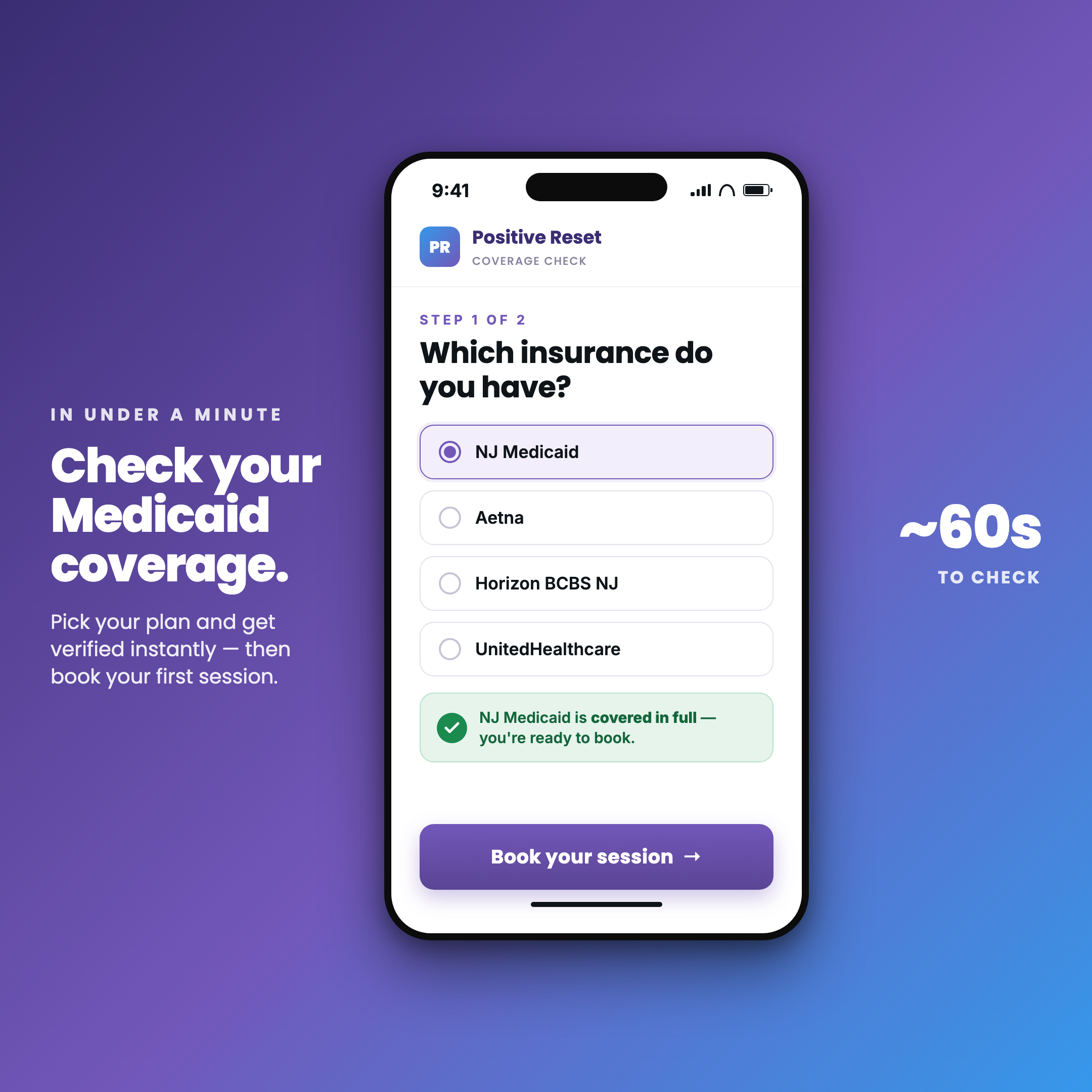
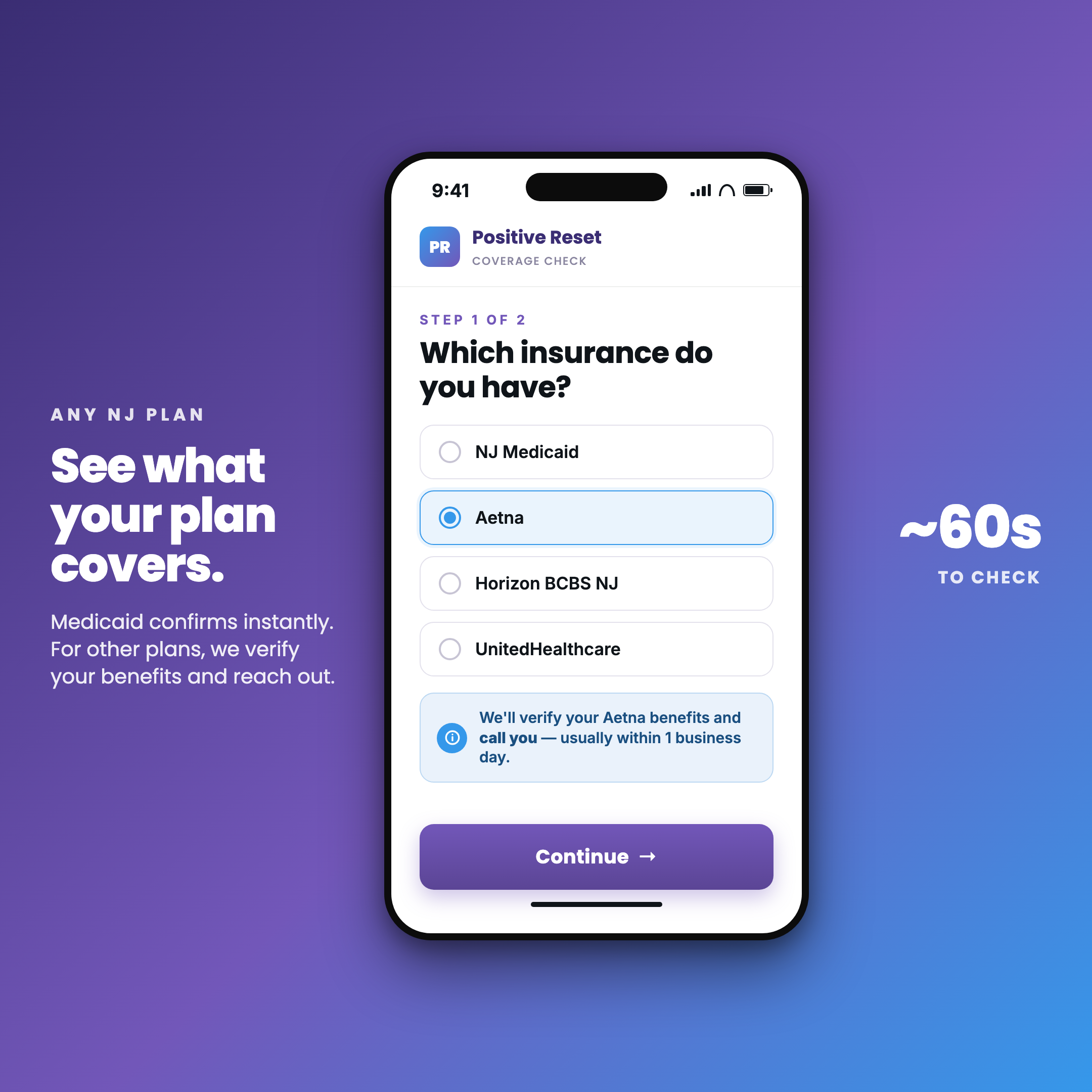
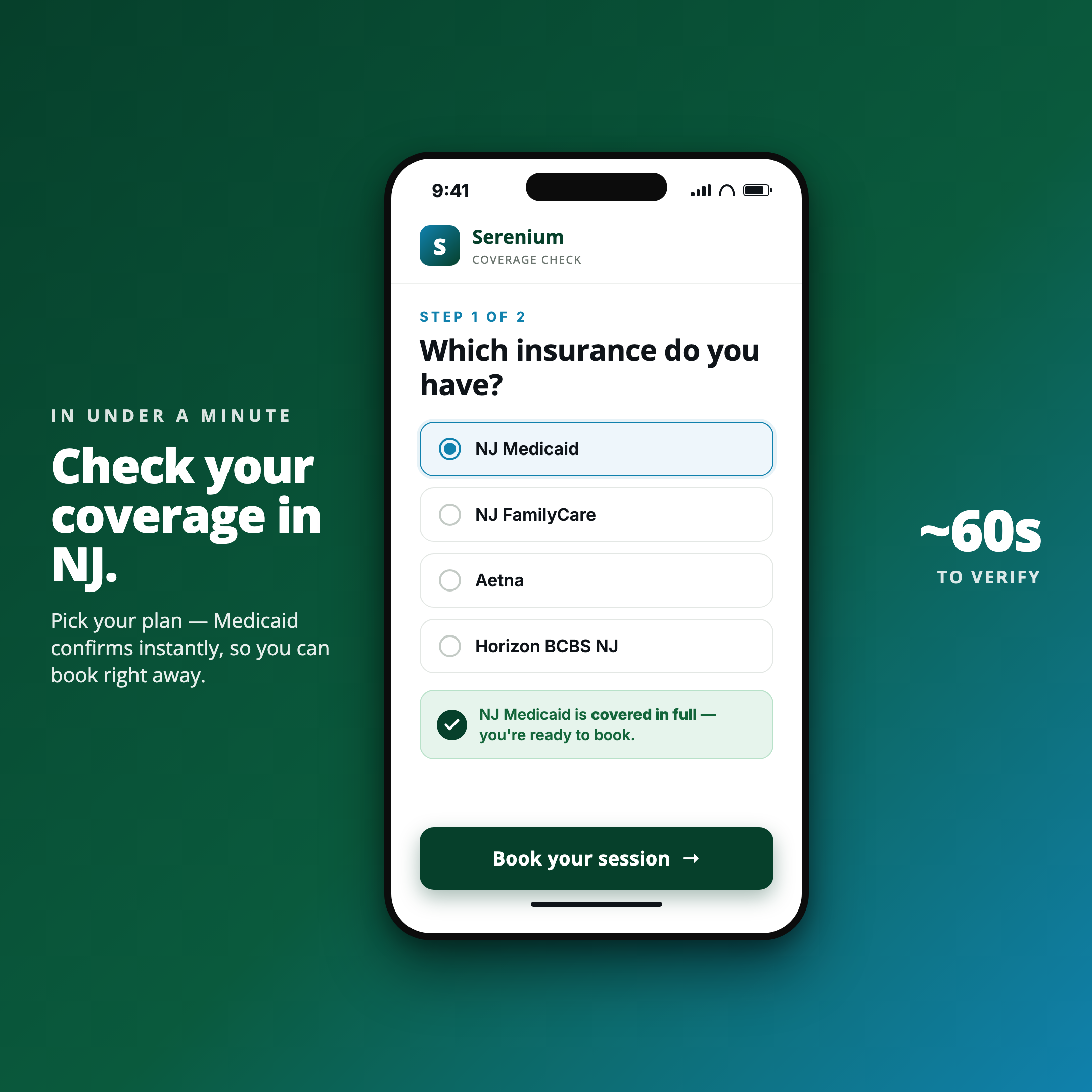
More kept drafts social · comparison · editorial · process


What we run on Google today live · last 30 days
Both brands run Medicaid-coverage Search — the exact "do you take my insurance?" intent the new flow answers. Serenium's account is ~10× PRE's and better-built (it already tests commercial carriers). Both are the natural home for the new booking flow, and both leak on brand terms.
One live campaign ("Therapy Covered by Medicaid"), ~$2.9k/mo, ~$8.40/click, essentially one broad keyword pulling a rich Medicaid-coverage stream. Roughly 1 in 5 dollars leaks — ~$550/mo to brand searches ("positive reset…") + off-topic terms ("anger management classes," "how to get medicaid").
Two live campaigns ("Therapy Covered by Medicaid" $21.4k + "Q2 General Medicaid Mental Health" $9.7k), ~$31k/mo, ~$10/click, ~596 conversions. Better structured (real ad groups + match types). Top performer: "nj familycare therapy" (~150 conv). Already bids on commercial carriers — Horizon BCBS, UnitedHealthcare, Aetna, AmeriHealth — so it's ahead of PRE on payer diversification. Same leaks: ~$2.5k+/mo on brand ("serenium wellness…") inside prospecting, plus weak spend ("stress therapy," 5 conv for $640) and 0-conv junk ("free anger management classes").
What we should do both accounts · no new budget for 1–4
Keyword themes from both accounts' converting searches
Real terms both accounts already get and convert on — not a guess. The map for the ad-group work. (For market-wide search volumes, CPC benchmarks, and competitor gaps, link SEMrush and I'll layer them on.)
| Theme | Real queries we already win | Move |
|---|---|---|
| Medicaid coverage (core, both) | "therapist that accept medicaid" · "therapy that takes medicaid near me" · "counseling that accepts medicaid" | Book flow → coverage check. The bread and butter. |
| NJ FamilyCare / carrier (SW's top) | "nj familycare therapy" · "horizon bcbs mental health" · "therapist that take amerihealth" | Own ad group per carrier — SW's biggest converter; extend to PRE. |
| Commercial payers (SW ahead) | "united healthcare mental health" · "therapy covered by aetna" · "therapist that takes horizon" | Pair with "know your copay" copy — diversifies beyond Medicaid. |
| Condition + coverage | "couples therapy medicaid" · "family counselling near me" · "medication management near me" | Tailored ad copy per service line. |
| Competitor coverage | "does betterhelp accept medicaid" | We win — BetterHelp doesn't take Medicaid, we do. |
| Brand (both leak) | "positive reset…" · "serenium wellness…" | Separate, cheap brand campaigns (move #2). |
| Exclude (negatives) | "how to get medicaid" · "free anger management classes" · "stress therapy" (weak) | Negatives / pause. |
To take the keyword work further
- Link SEMrush (API or MCP) and I'll add real search volumes, CPC benchmarks, and the competitor gap — what BetterHelp / Talkspace / local NJ clinics rank + bid on that we don't, per brand.
- Or I can pull the same from Google's own Keyword Planner — free.
How we'll know it worked so we can prove it
North-star: cost per patient who actually shows up (an attended appointment), split Medicaid vs commercial, per brand. On top of that, marketing reads the team's booking-first vs intake-first A/B (an on-site funnel test) and separately A/B-tests our outcome ad angles — all judged on cost-per-attended, not clicks. One dependency: the ad tag has to survive the new booking page (companion doc, Lock 1) — without it, both reads go dark.
Worth putting on the table easy to miss
Prioritized roadmap
- Finalize the comms-journey copy (book → intake → coverage+cost → reminders) + Serenium variant, for the Sat 11am working session.
- Ship the outcome-led ad set (book-now CTA) for PRE — refreshed C1/C3 heroes + variants.
- Hand engineering the 3 must-locks (companion doc): attribution passthrough · dedup + brand at book-time · old-cycle suppression.
- Confirm PRE-first soft launch; keep lead-form ads as fallback.
- Cost-per-attended dashboard (Medicaid vs commercial) + the booking-first vs intake-first A/B read.
- Reactivation pilot to one dormant segment (consent-gated, 6-month copy).
- Reminder + no-show rebook sequences on the appointment time.
- Google Ads: point PRE + SW at the booking flow; carve out brand on both.
- Seed booked/attended audiences for Meta lookalikes.
- Full Serenium creative + comms rollout (once PRE is proven).
- Google Ads: rebuild PRE ad groups on SW's template + "know your copay" commercial push.
- "Browse your therapist" + cost-transparency + Spanish-language sets.
- Retention (2nd-session) + coverage-check SEO page.
- Google Business Profile + review-request loop (secondary).